What going viral felt like
This happened because I finally took a new headshot for the first time in five years.
My youngest had just started walking. I was regaining independence and feeling more settled into my skin as a mom of two. I was working from home and happened to look presentable since I had meetings that morning. My mom was already downstairs watching the girls, so I signed off from work and handed her my camera, asking her to snap a couple photos of me in the backyard.
It was a quick and simple task, but the outcome meant the world to me. For years, I wanted an updated photo for work that represented the woman I am today. And I finally got one.
There just happened to be a throwback trend making its way to my FYP that week. It consisted of sharing a photo of yourself in 2026, followed by a photo of yourself in 2016. The song was set to New Flesh by Current Joys.
I listened to The Cure
I listened to The Cure
I listened to The Cure
And then I cried
Fitting lyrics, considering the trend juxtaposed romanticized memories of the past with the realities of the present.
In many of the posts I saw, the transformations seemingly made sense. People simply looked like a more mature version of themselves a decade ago. Their style and self-expression remained consistent, just more refined. It appeared that both photos were taken for a similar audience.
The contrast between my two photos was jarring. I paired my new LinkedIn headshot with a photo I had shared on Instagram. They were taken for completely different purposes.
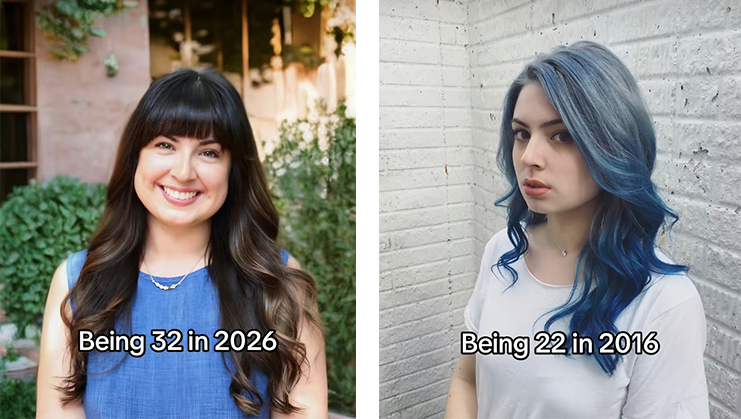
In 2016, my goal was creative expression and external validation. I was posing for the camera with a full face of makeup and blue hair. I was intentionally not smiling, attempting to depict a sense of allure and mystery. My head was turned to the side to achieve what I deemed a more flattering angle: one that minimized my strong jawline, which I was very insecure about at the time. I was catering to the gaze of alternative youth.
In 2026, my goal was to represent myself as a corporate professional. My hairstyle was different and the color was natural. The angle was straight-on, and I was smiling, fully inhabiting myself. No hiding my jawline, which I’ve come to accept and love as part of me. I was catering to the gaze of my professional network.
Combining these two photos into a post was an exercise in self-reflection. I have a great deal of respect for my journey and personal growth over the last decade. I’ve confronted old thought patterns and behaviors that no longer serve me. I’ve survived having my identity destroyed and rebuilt through new motherhood. I was still tender from the transition, but I felt content with where I had landed, knowing I wasn’t finished becoming. I titled my post, The Mother and the Maiden.
The blue hair is gone, along with the endless free time. But I still carry her with me.
I hadn’t shared a selfie in a long time. I’d been tending to my life and deeply immersed in my inner world over the last five years. My infrequent posts on TikTok were shared for my own amusement. The focus was not on my looks but on sentiments about motherhood, my love for my family, and silly moments. I had almost forgotten how superficial the internet was until I presented myself to it.
I thought it would get minimal reach, just as my other posts had. I was wrong.
It took off over the course of three days. Many people were kind and complimentary of the girl with blue hair in 2016, with some calling her “the blueprint.” Many didn’t care for my appearance today and speculated on what must have led to such a downgrade.
Some comments were funny. Some were disgusting. Regardless of phrasing, the implication was that I was less desirable in 2026.
She lost herself.
She lost her spark.
She didn’t age well.
She must have gotten married and had kids.
She conformed to society.
She should go back to her old style.
It was dehumanizing. An audience on TikTok reduced my entire identity to two photos, then publicly shamed and ridiculed me with their assumptions. But I am no stranger to appearance-based judgment. As a woman, my very existence is chronically policed by others. I am a walking invitation for commentary and opinion. I’ve been the subject of both positive and negative criticism my entire life, from others and from myself.
An internet mob ridiculing the girl with blue hair would have devastated her in 2016. She would’ve permanently deleted her Instagram out of shame and embarrassment. She would have believed she was the problem.
But the woman in 2026 knows better. She knows that the people who commented are not bad people. They gathered beneath her image and jeered, holding torches and pitchforks, because their worldview probably prevents them from understanding her story. And it’s possible they never will.
Accepting myself has been a lonely and painful process. I have been hiding. I have felt fragmented. I have felt inauthentic. For years, I compartmentalized various areas of my life, presenting different versions of myself to different audiences: work, family, friends, and acquaintances. I was terrified of sharing my thoughts and feelings. I was afraid of judgment.
Going viral helped me remember that, regardless of audience or intent, judgment is inescapable. It is inevitable. It is simply a part of life. The only thing I have control over is how I respond to it. And I’m tired of hiding.
My past, present, and future have all aligned through this experience. The lessons I’ve learned about myself, my skills and education, and the countless photos and videos I’ve taken through the years all come together to represent me in the digital world. Since that initial throwback post went viral, I’ve continued creating content that I find meaningful and sharing it consistently. I’m growing more comfortable with using my voice and being visible in this space. I’ve started referring to this creative process as alchemy: bringing seemingly unrelated, ordinary pieces of my life together to tell a story.
I can’t help but feel like this was part of my destiny. The grueling battle to love and accept myself culminated in a single moment of public scrutiny—something that was my biggest fear for the longest time.
And it didn’t break me.
It inspired me.
